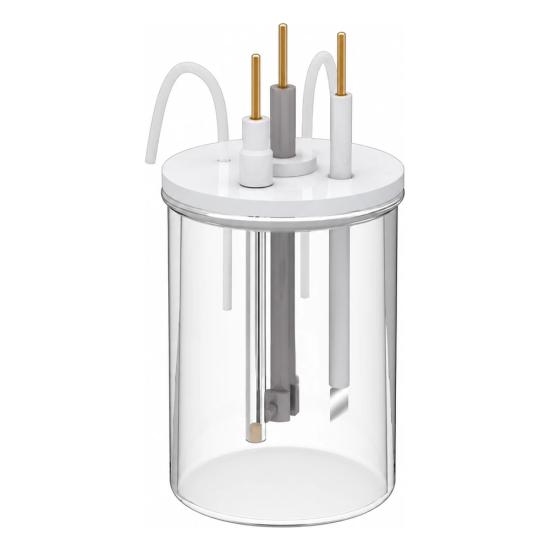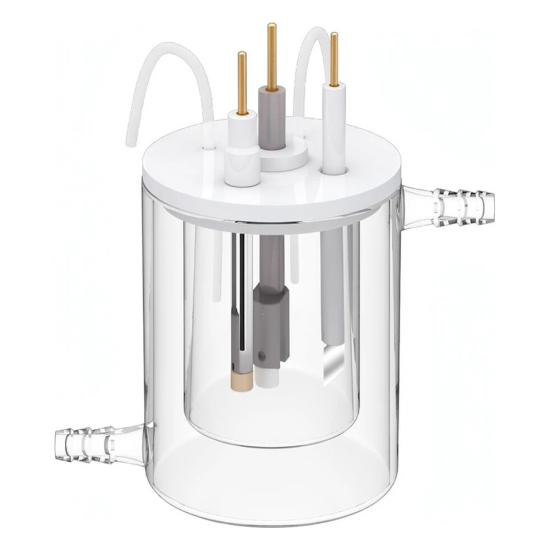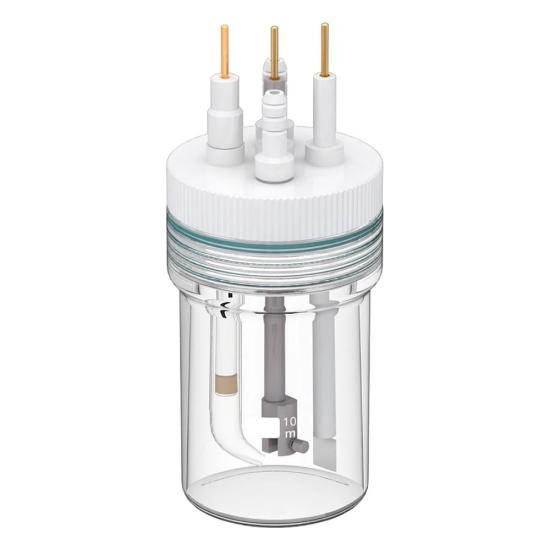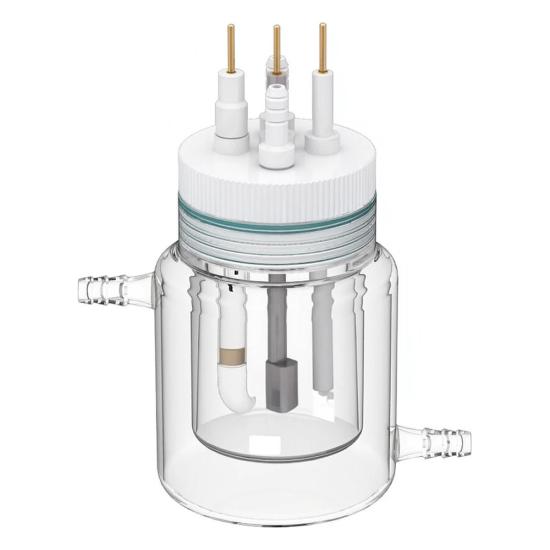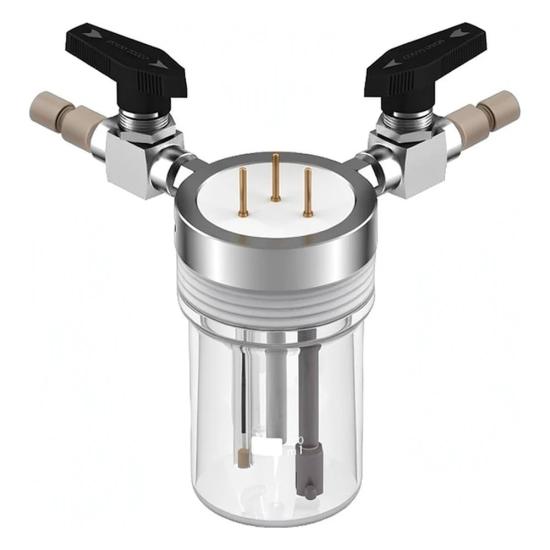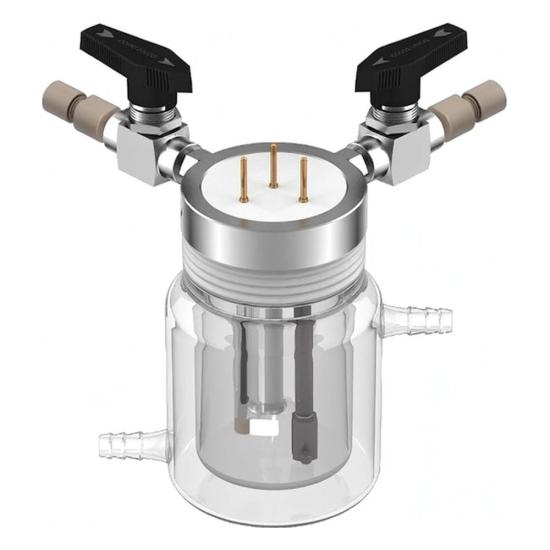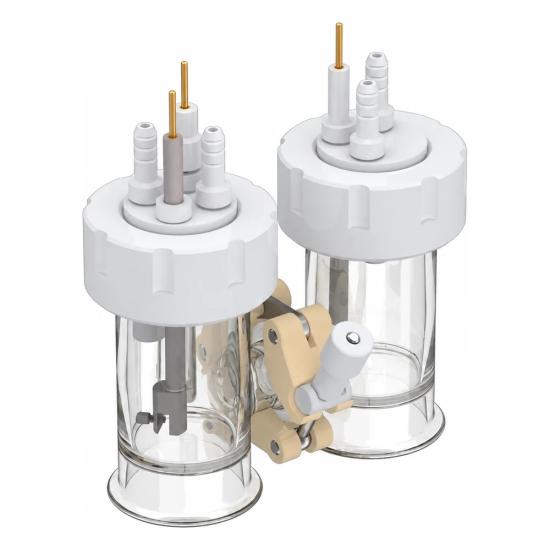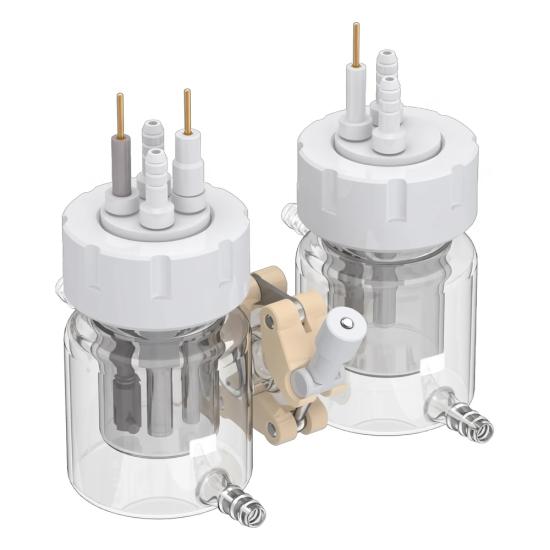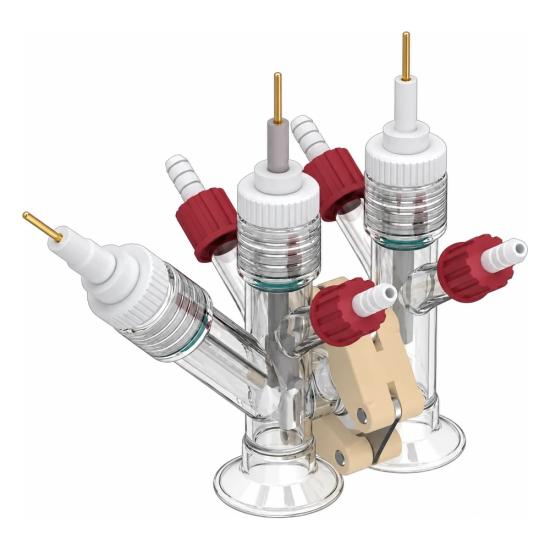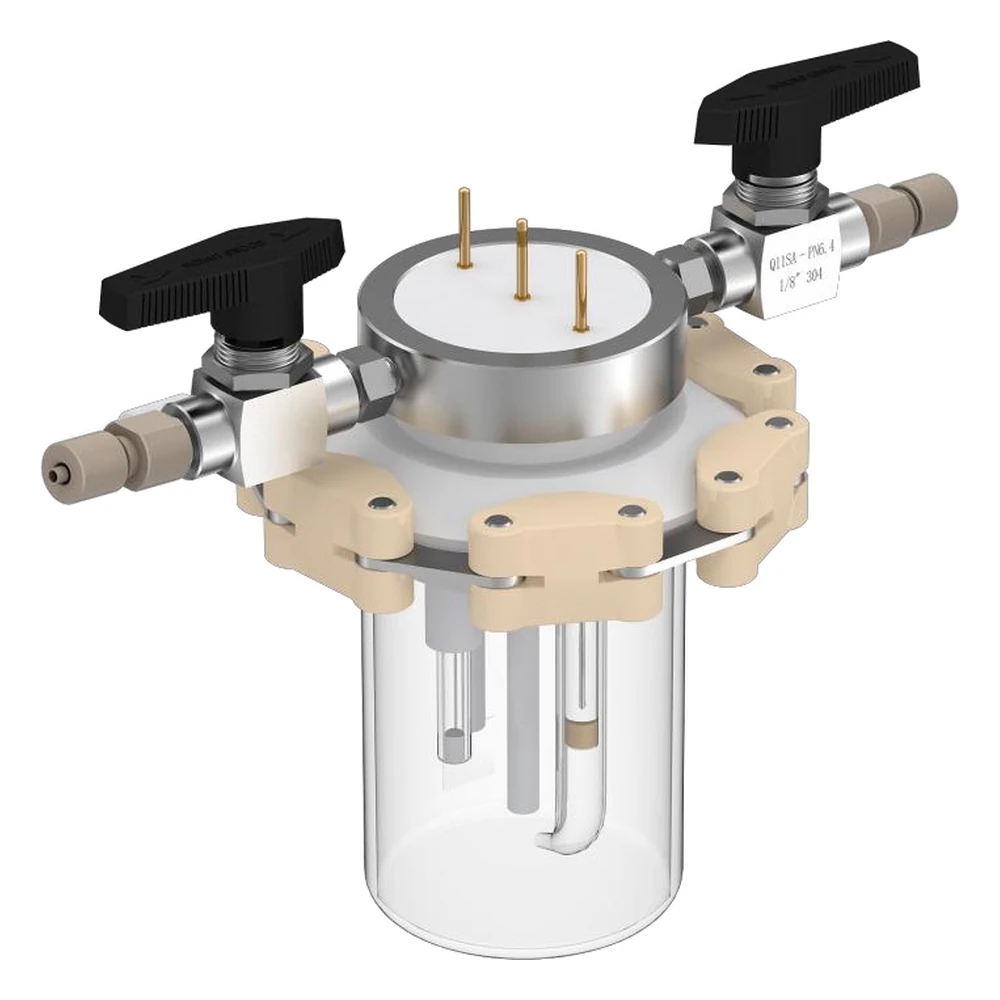
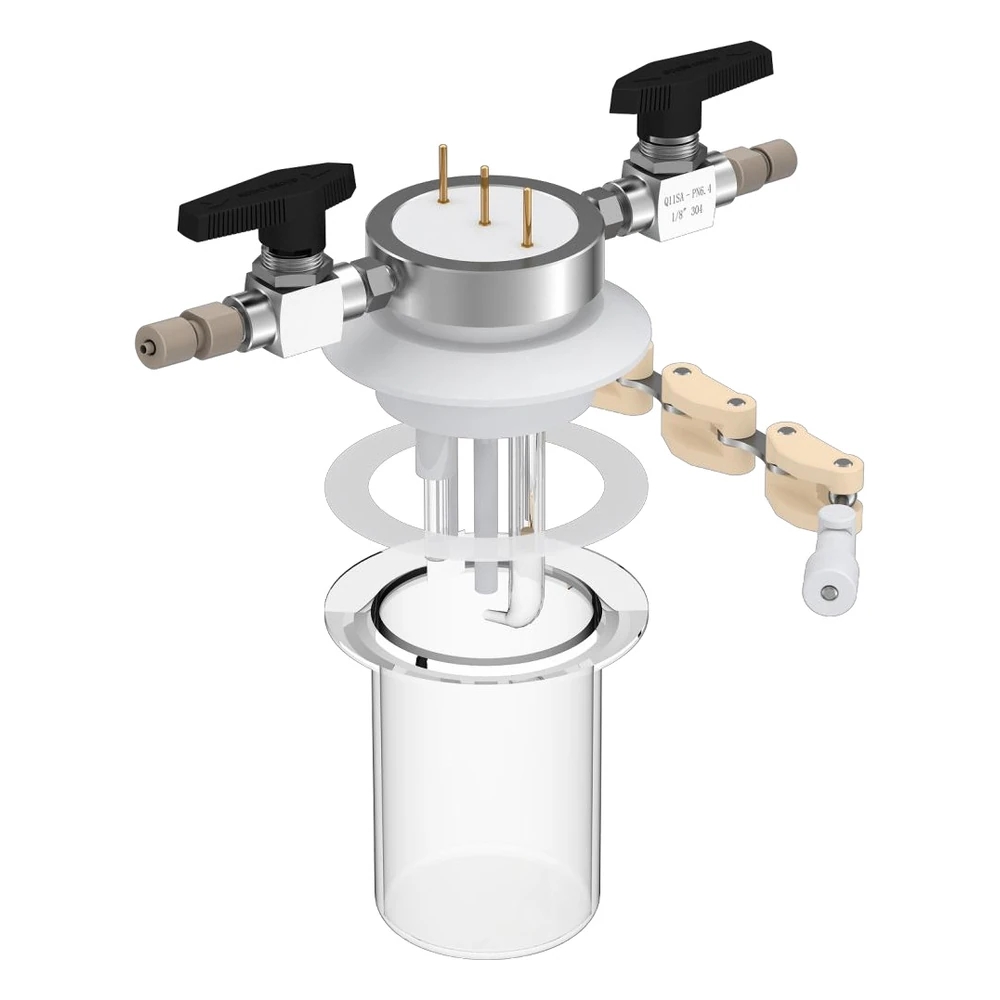
The absolutely sealed flanged cylindrical quartz cell has a fusion-welded quartz body with transmittance above 95% (manufacturer data). The quartz flange and PTFE lid are closed on a gasket with a locking ring; the electrodes plug into socket connections inside the lid.
It is usually used with a Ø3.8 mm Ag/AgCl reference, a Ø0.5 mm platinum wire or platinum sheet counter and a glassy carbon working electrode; the working electrode can be replaced by a 3 mm gold, platinum or another electrode holder. Electrodes are sold separately and must be made to fit the cell.
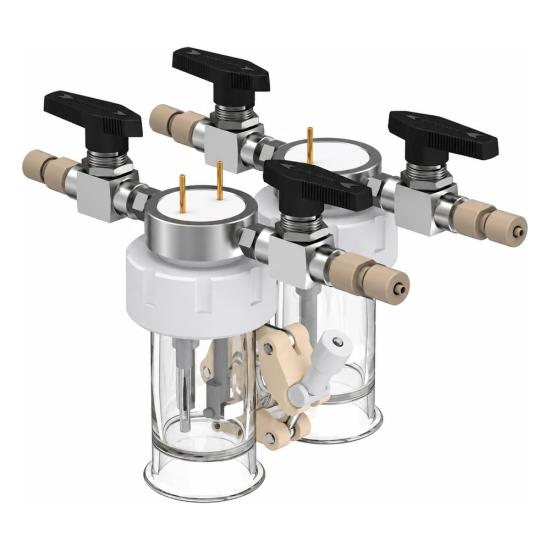
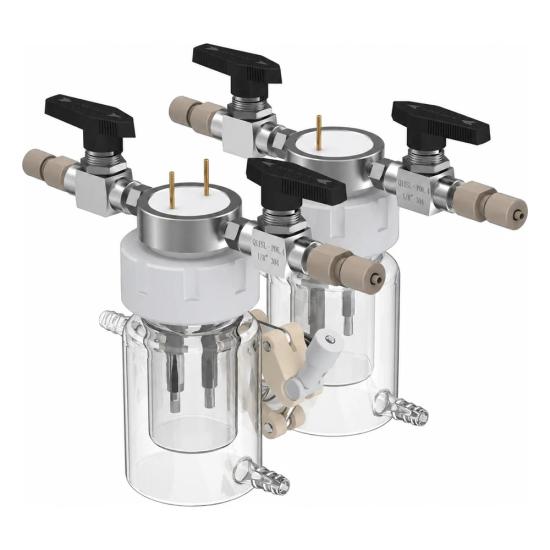
In the absolutely sealed cell the electrodes plug into socket (jack) connections inside the lid, isolating the system completely from the outside. With valves fitted, the cell can be evacuated (below −100 kPa) or operated under slight pressure (max. 0.5 MPa, manufacturer data). The electrodes are made to fit this cell and must be ordered together with it.
Quartz (fused silica) transmits light from about 190 nm up to the near infrared, while borosilicate glass largely blocks UV light below about 320 nm. Quartz is therefore used for UV-Vis spectroelectrochemistry and photoelectrochemical work with UV light. Quartz is not resistant to hydrofluoric acid (HF).
| Cell type | Flanged cylindrical quartz cell, absolutely sealed |
| Volume | 50 mL |
| Dimensions | OD 55 mm, ID 50 mm, height 52 mm (effective 35 mm) |
| Body | Quartz, fusion-welded |
| Electrode connection | Socket (jack) in the lid |
| Valve | Sold separately |
| Not included | Electrodes (sold separately) |
Valves are not included in the price. The valve kit for gas purging and vacuum is offered as a separate product (LM-EC-CELL-VALVE) and is ordered together with the cell.
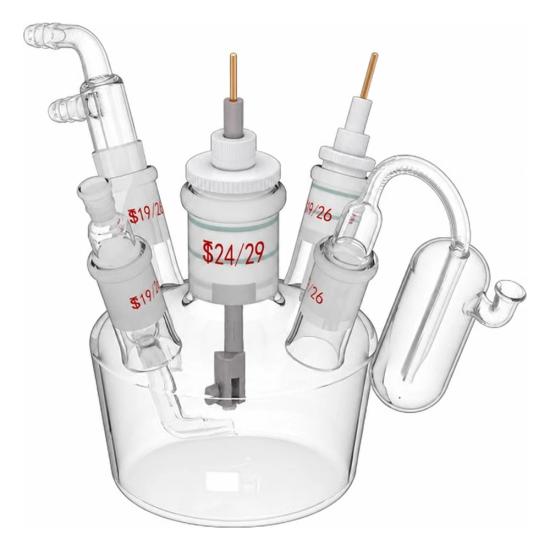
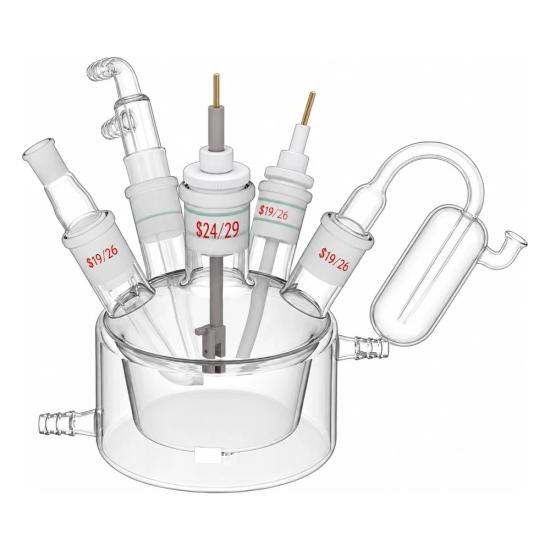
Electrodes and membranes shown in the photos are for illustration only and are not included in the price. Compatible reference, counter and working electrodes and membranes are available in the Electrodes category of our site.
For volumes, dimensions or port layouts other than those listed, you can request a custom-made quotation through the Quotation Form.


 Türkçe
 Engilish