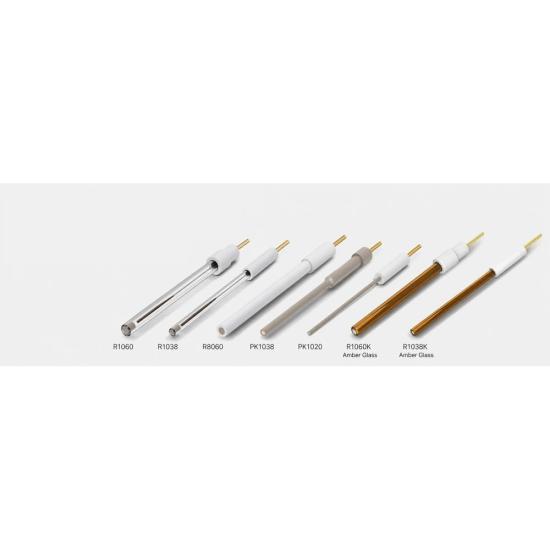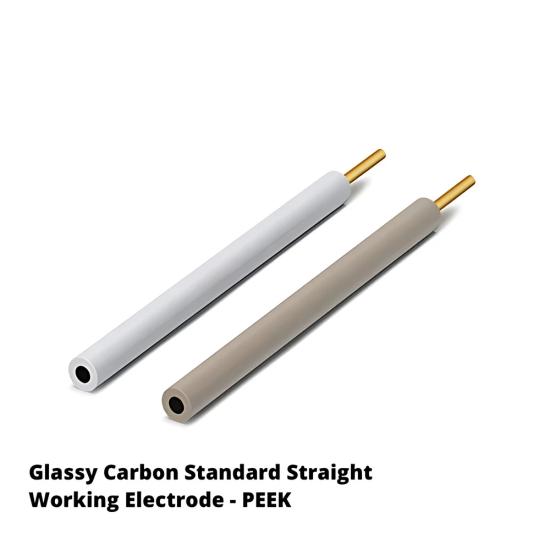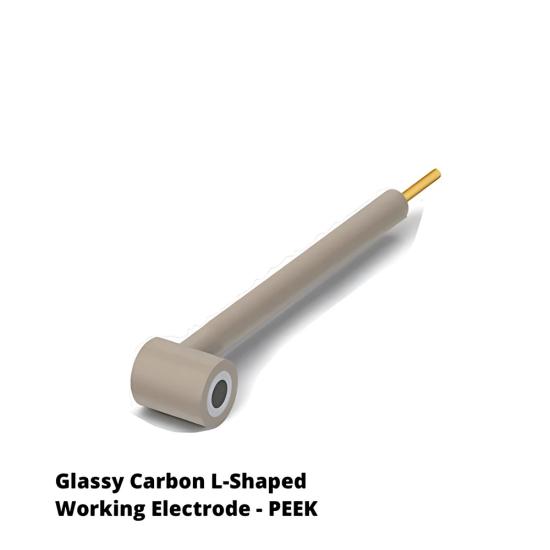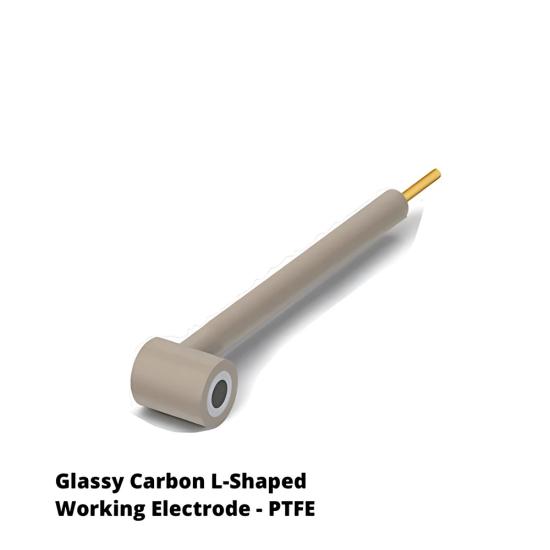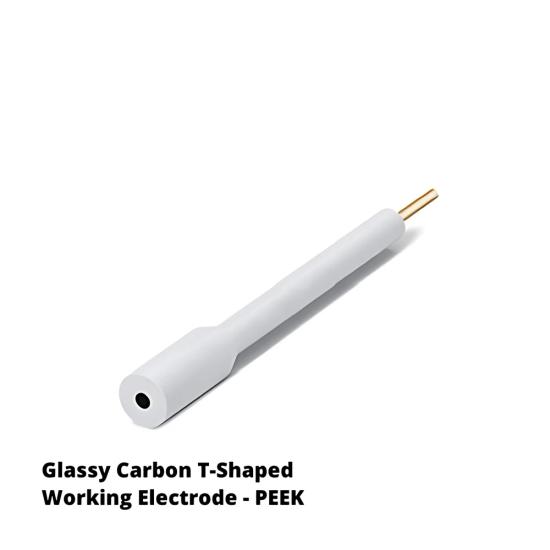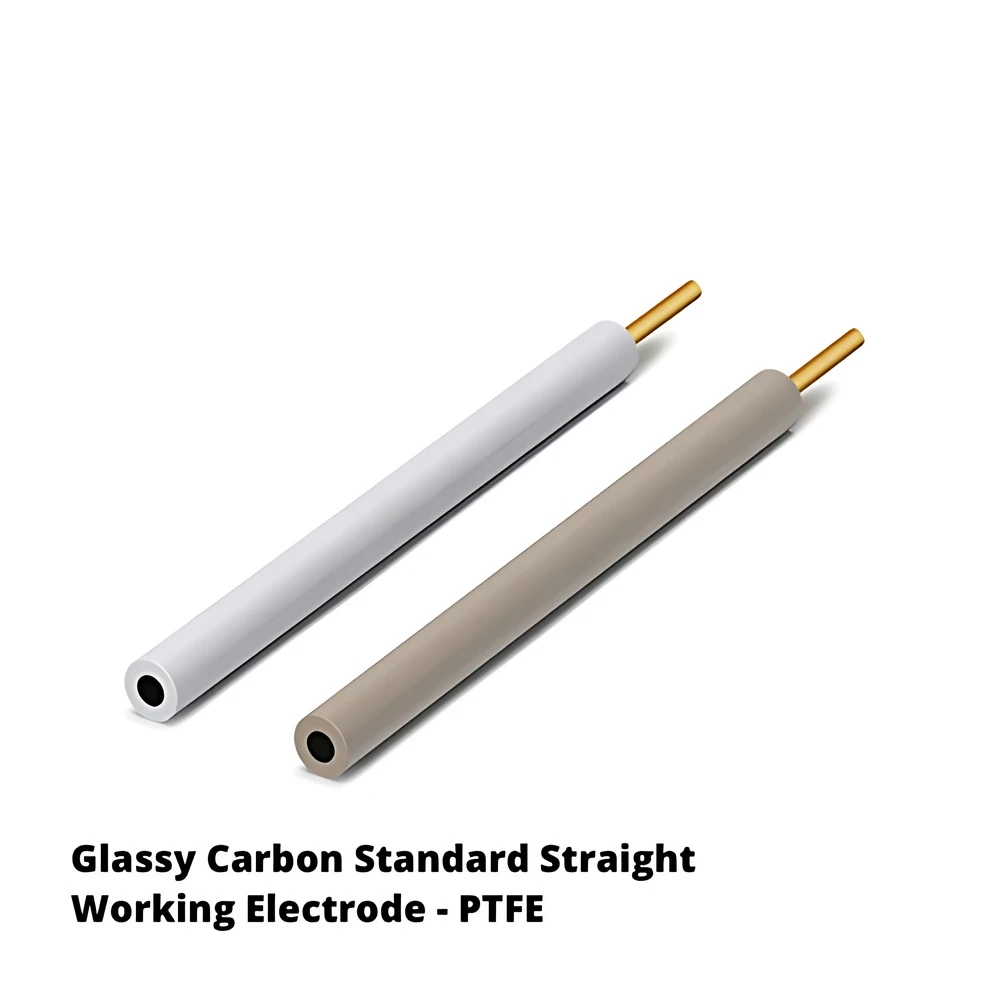
The active surface is a flat glassy carbon disk at the tip of an insulating body. Glassy carbon is the most common type of carbon electrode: it is chemically stable and, because of its high overpotential for hydrogen and oxygen evolution, works over a wide potential range. It is widely used in cyclic voltammetry, sensor development and electrocatalysis tests with drop-cast catalyst ink.
This model has a standard straight PTFE body, with the glassy carbon disk at the tip, in line with the rod. Disk diameters: Ø1–6 mm (US) or Ø1–10, 15, 20 mm (Japan). PTFE is inert to nearly all acids, bases and solvents, so it also suits electrolytes that attack PEEK, like concentrated sulfuric acid. It is soft, so avoid scratching or denting it. PEEK, L- and T-type versions are on separate pages.
| Electrode type | Glassy carbon disk working electrode |
| Electrode shape | Standard straight rod; disk on the end face, in line with the body axis |
| Body material | PTFE (polytetrafluoroethylene) |
| Disk diameter | US-origin: 1, 2, 3, 4, 5, 6 mm · Japan-origin: 1–10, 15, 20 mm |
| Glassy carbon length | 5–10 mm (manufacturer data) |
| Body / total length | 60 mm / ≈75 mm (manufacturer data) |
| Connection | Gold-plated pin |
| Approx. potential window (vs. RHE) | 0.1 M H₂SO₄: ≈ −0.42 to +1.76 V · 0.1 M NaOH: ≈ −0.64 to +1.66 V; depends on electrolyte and purity |
| Polishing | Alumina slurry on microcloth (final step 0.05 µm), then rinse with pure water; if needed, ultrasonic cleaning for no more than 5 minutes |
| Body chemical resistance | Inert to nearly all chemicals and solvents; attacked only by very reactive substances such as elemental alkali metals, elemental fluorine and chlorine trifluoride |
| Operating temperature | Not specified for this product. One electrode maker recommends 10–25 °C for similar PTFE-body disk electrodes; a body expanding with heat can break the seal |
| Origin and Diameter | Description |
| US-Origin 1 mm | US-origin glassy carbon, Ø1 mm disk |
| US-Origin 2 mm | US-origin glassy carbon, Ø2 mm disk |
| US-Origin 3 mm | US-origin glassy carbon, Ø3 mm disk |
| US-Origin 4 mm | US-origin glassy carbon, Ø4 mm disk |
| US-Origin 5 mm | US-origin glassy carbon, Ø5 mm disk |
| US-Origin 6 mm | US-origin glassy carbon, Ø6 mm disk |
| Japan-Origin 1 mm | Japan-origin glassy carbon, Ø1 mm disk |
| Japan-Origin 2 mm | Japan-origin glassy carbon, Ø2 mm disk |
| Japan-Origin 3 mm | Japan-origin glassy carbon, Ø3 mm disk |
| Japan-Origin 4 mm | Japan-origin glassy carbon, Ø4 mm disk |
| Japan-Origin 5 mm | Japan-origin glassy carbon, Ø5 mm disk |
| Japan-Origin 6 mm | Japan-origin glassy carbon, Ø6 mm disk |
| Japan-Origin 7 mm | Japan-origin glassy carbon, Ø7 mm disk |
| Japan-Origin 8 mm | Japan-origin glassy carbon, Ø8 mm disk |
| Japan-Origin 9 mm | Japan-origin glassy carbon, Ø9 mm disk |
| Japan-Origin 10 mm | Japan-origin glassy carbon, Ø10 mm disk |
| Japan-Origin 15 mm | Japan-origin glassy carbon, Ø15 mm disk |
| Japan-Origin 20 mm | Japan-origin glassy carbon, Ø20 mm disk |
For sizes and specifications not listed above, you can request a custom quotation through the Quote Form.


 Türkçe
 Engilish