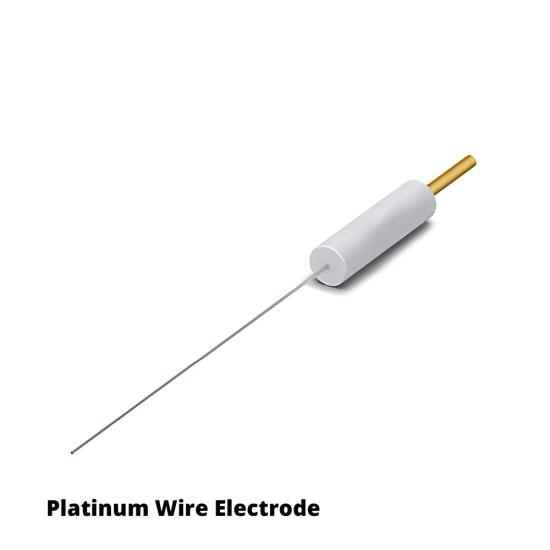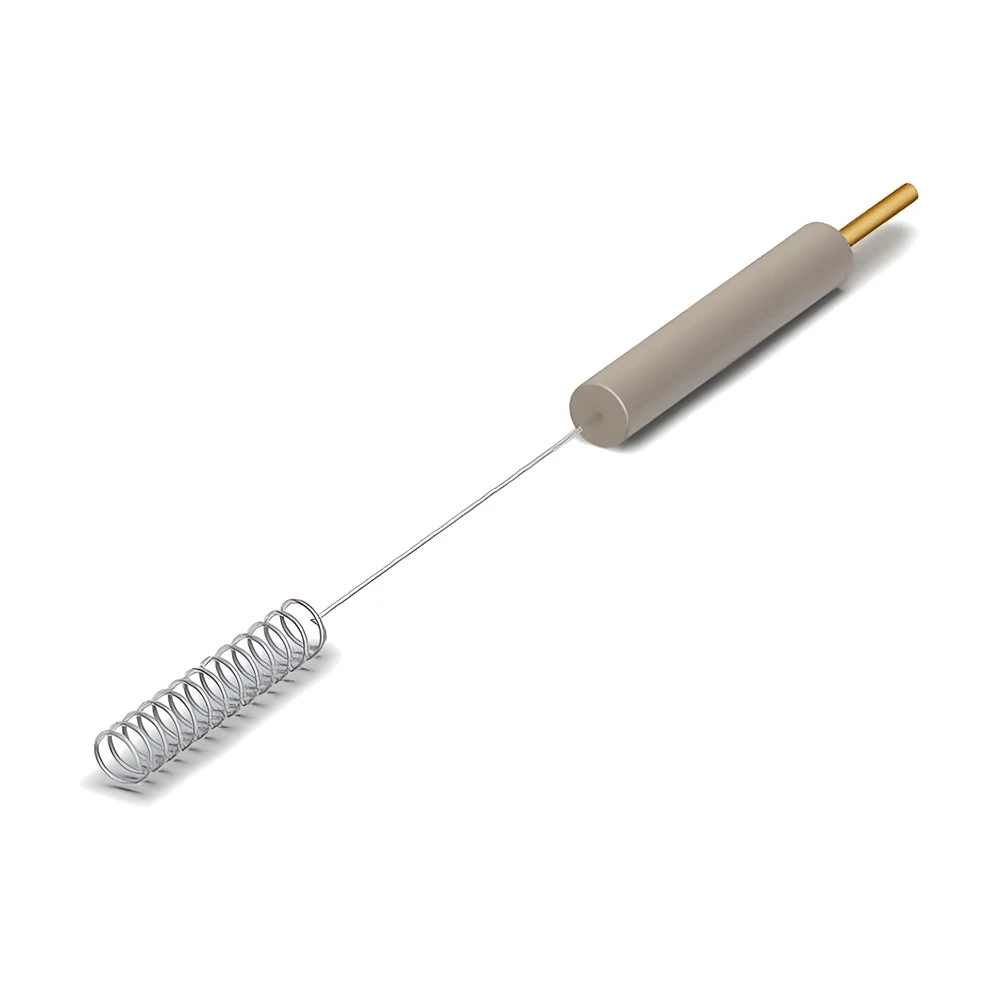
The platinum spiral wire counter electrode is made from Ø0.5 mm platinum wire with 230 mm exposed length, the end of which is wound into a spring (spiral) of about Ø4 mm. This packs the surface area of a long wire into a small volume inside the cell.
It is used as the auxiliary electrode that closes the current circuit in a three-electrode cell, while the potential is measured against the reference electrode. A common rule of thumb is a counter electrode area of at least about three times the working electrode area; a spiral wire meets this more easily than a short straight wire. The salt bridge model is meant for set-ups where products formed at the counter electrode must not reach the main solution.
| Electrode type | Platinum spiral wire counter (auxiliary) electrode with insulating body |
| Electrode material | Platinum |
| Wire diameter | Ø0.5 mm |
| Exposed wire length | 230 mm |
| Spiral (spring) diameter | About Ø4 mm (manufacturer data) |
| Approx. geometric area (π·d·L) | ≈3.6 cm² (if all exposed wire is immersed) |
| Salt bridge model | PT052300 |
| Compatible media | Widely used as a counter electrode in aqueous acid media (e.g. H₂SO₄). In organic solvents the solvent compatibility of the insulating body must be checked separately |
| Platinum dissolution / redeposition | At high anodic potentials and in long or many-cycle experiments platinum can dissolve and redeposit on the working electrode; in tests of Pt-free catalysts this can make the activity look higher than it is. For such work prefer a graphite/glassy-carbon counter electrode or a separate compartment |
| Cleaning | After use rinse with a suitable solvent, then with high-purity water; check the surface for deposits and run a blank scan if cross-contamination is possible. Do not flame-anneal electrodes with a polymer body |
| Mechanical note | Platinum wire is thin and fragile; do not stretch the spring or bend the wire repeatedly. A broken wire cannot be repaired |
| Connection | Connects to the counter electrode (CE/auxiliary) lead of the potentiostat. Contact pin type and cell/cable fit can be confirmed before ordering |
| Custom production | On request (size) |
| Model | Description |
| PT0523 Ø0.5 × 230 mm | Exposed wire: Ø0.5 × 230 mm |
| PT052300 Salt Bridge Ø0.5 × 230 mm | With salt bridge, exposed wire: Ø0.5 × 230 mm |
For sizes and specifications not listed above, you can request a custom quotation through the Quote Form.


 Türkçe
 Engilish