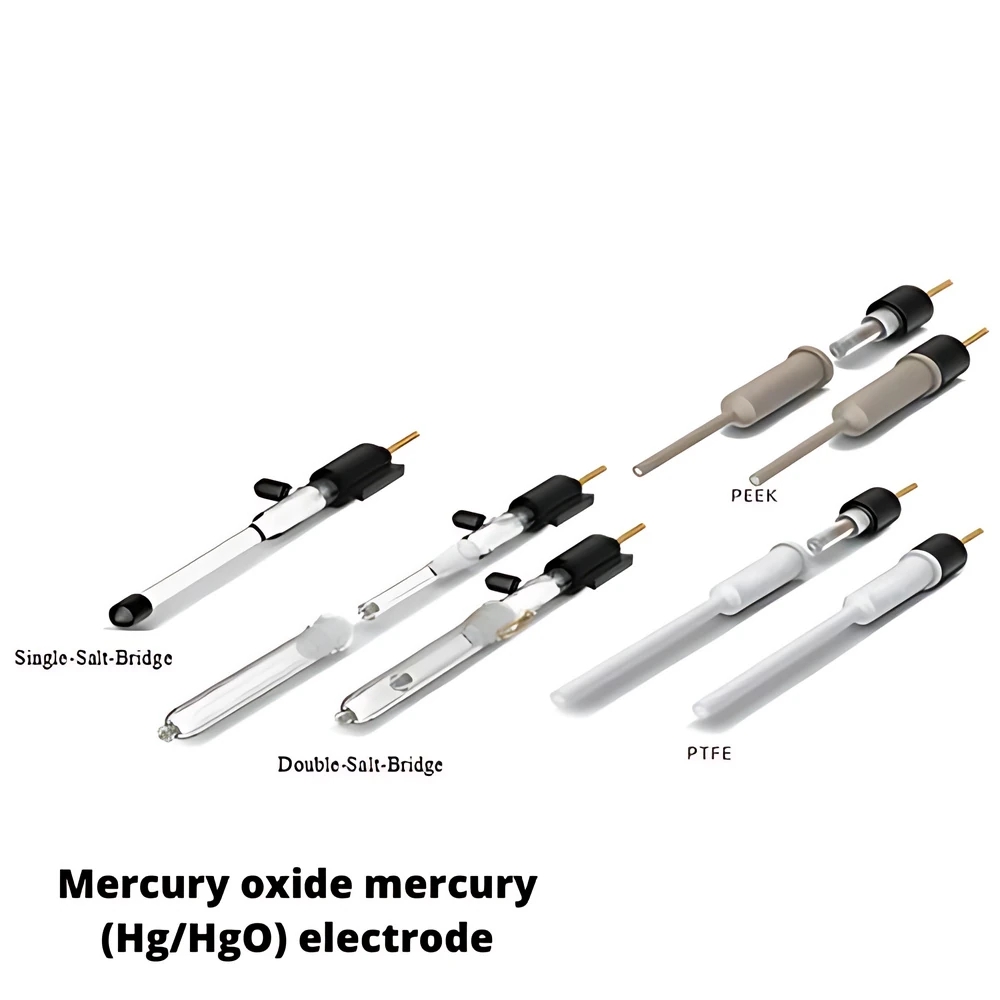
The mercury/mercuric oxide electrode is a reference electrode in which mercury and HgO are in contact with an alkaline solution (HgO + H₂O + 2e⁻ ⇌ Hg + 2OH⁻). In this product the internal filling is 1 M KOH. It is used where Ag/AgCl and SCE cannot survive alkaline media or would contaminate them with chloride, which makes it a common choice for alkaline water electrolysis, alkaline batteries and KOH-electrolyte systems.
In 1 M KOH its potential is about +0.10 V vs. SHE. Using the same alkali at the same concentration inside and outside reduces junction potential and contamination; if the test solution is more concentrated than 1 M, choose the salt bridge model. Since glass bodies can be attacked by concentrated alkali over time, PTFE or PEEK body options may be preferred for long tests. The electrode contains mercury; KOH is corrosive.
| Electrode type | Mercury/mercuric oxide reference electrode, HgO + H₂O + 2e⁻ ⇌ Hg + 2OH⁻ |
| Internal filling solution | 1 M KOH |
| Potential (vs. SHE, 25 °C) | ≈ +0.10 V (1 M KOH); about 0.098–0.11 V depending on the source |
| Conversion to RHE scale | E(RHE) = E(Hg/HgO) + ≈0.10 V + 0.0592 × pH; in 1 M KOH (pH ≈ 14) the total offset is about +0.93 V |
| Suitable media | Alkaline systems; used in alkaline solutions only |
| If test solution > 1 M | Use of a salt bridge (double salt bridge model) is recommended |
| Internal/external solution match | Where possible work in the same alkali and concentration as the filling; a different concentration shifts the potential, so calibrate against RHE before use |
| Temperature | In concentrated alkali at high temperature glass bodies and junctions can degrade over time; prefer PTFE/PEEK for long or hot tests, keep the temperature constant and report it |
| Storage and care | Store in the same alkaline solution as the filling; do not let the tip dry out. After refilling, allow several hours to equilibrate before use |
| Chloride interference | Chloride-free; a substitute for Ag/AgCl in chloride-sensitive alkaline systems |
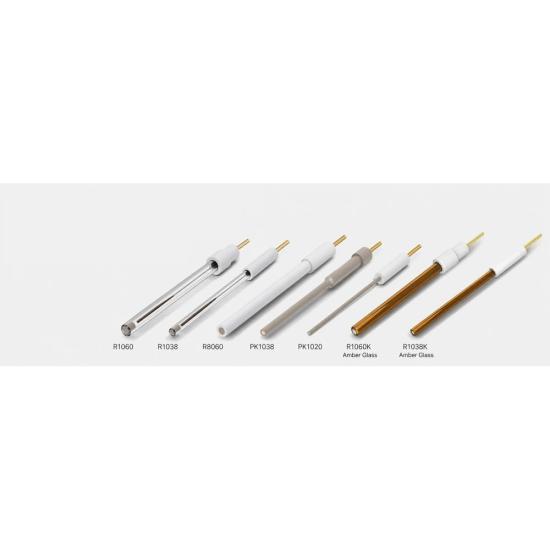
| Body | Glass, PTFE or PEEK (depending on model) |
| Hazard note | Contains metallic mercury and HgO; 1 M KOH is corrosive. Wear gloves and eye protection, dispose of waste as hazardous waste |
| Model | Description |
| Standard | Single salt bridge, standard length |
| Long | Extended length |
| Slim 3.8 mm | Slim 3.8 mm diameter body |
| Double Salt Bridge | Double salt bridge design |
| PTFE Body | Polytetrafluoroethylene (PTFE) body |
| Hg-1038 PEEK Body | PEEK body model |
For sizes and specifications not listed above, you can request a custom quotation through the Quote Form.


 Türkçe
 Engilish