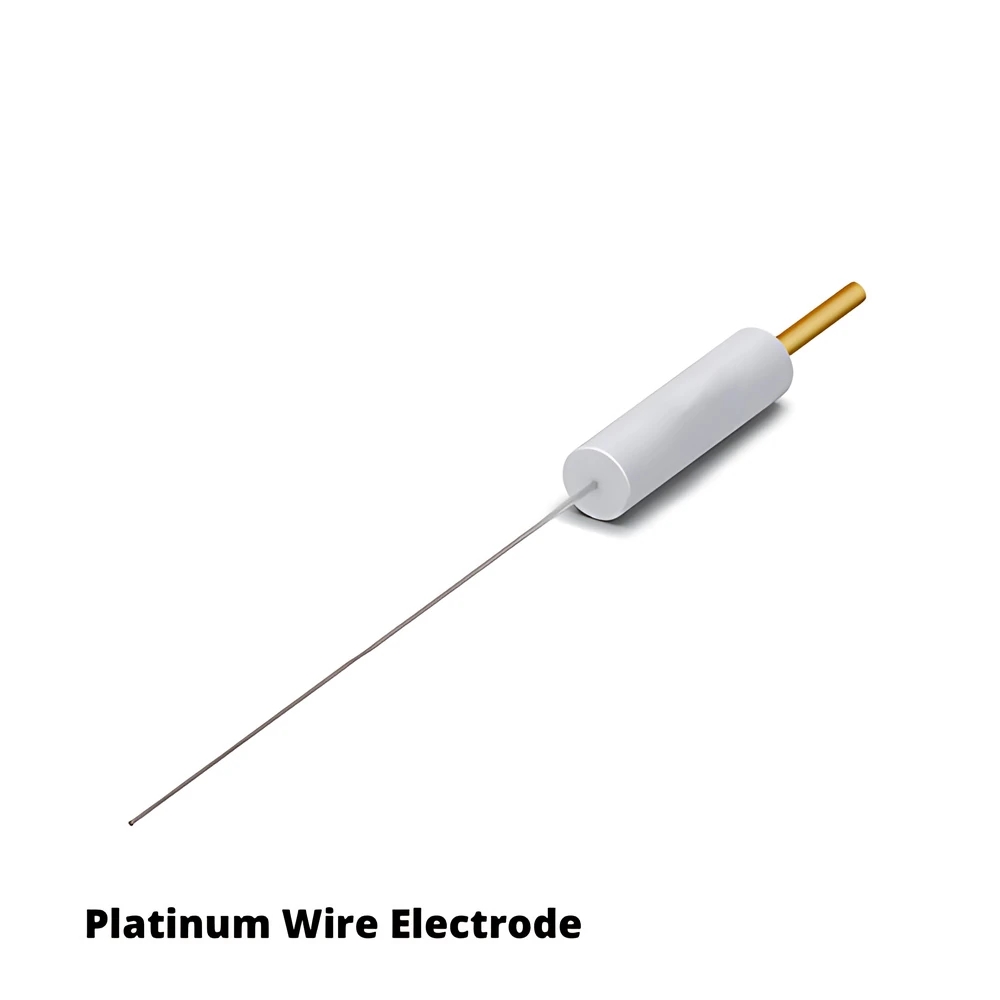
The platinum wire counter electrode is the auxiliary electrode of a three-electrode cell: it closes the current circuit by carrying out the reverse of the reaction at the working electrode, while the potential is measured against the reference electrode. Platinum is chemically inert in most media, which makes a Pt wire the standard choice for routine voltammetry and low-current work.
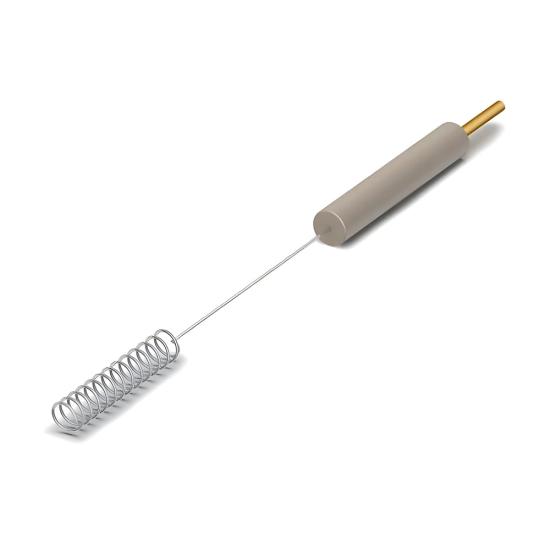
A short straight wire fits narrow cell ports easily, but its surface area is small and set by the exposed length and diameter. A common rule of thumb is a counter electrode area of at least about three times the working electrode area; for set-ups that need more area a 230 mm platinum spiral wire is offered as a separate product, and a mesh or sheet suits high currents or long electrolysis runs.
| Electrode type | Platinum wire counter (auxiliary) electrode with insulating body |
| Electrode material | Platinum |
| Wire diameter | Ø0.5 mm (PT0537) or Ø1.0 mm (PT1037) |
| Exposed wire length | 37 mm |
| Approx. geometric area (π·d·L, end face excluded) | PT0537: ≈0.58 cm² · PT1037: ≈1.16 cm² |
| Compatible media | Widely used as a counter electrode in aqueous acid media (e.g. H₂SO₄). In organic solvents the solvent compatibility of the insulating body must be checked separately |
| Platinum dissolution / redeposition | At high anodic potentials and in long or many-cycle experiments platinum can dissolve and redeposit on the working electrode; in tests of Pt-free catalysts this can make the activity look higher than it is. For such work prefer a graphite/glassy-carbon counter electrode or a separate compartment |
| Cleaning | After use rinse with a suitable solvent, then with high-purity water; check the surface for deposits and run a blank scan if cross-contamination is possible. Do not flame-anneal electrodes with a polymer body |
| Mechanical note | Platinum wire is thin and fragile; repeated bending will break it and it cannot be repaired |
| Connection | Connects to the counter electrode (CE/auxiliary) lead of the potentiostat. Contact pin type and cell/cable fit can be confirmed before ordering |
| Custom production | On request (size) |
| Model | Description |
| PT0537 Ø0.5 × 37 mm | Exposed wire: Ø0.5 × 37 mm |
| PT1037 Ø1.0 × 37 mm | Exposed wire: Ø1.0 × 37 mm |
For sizes and specifications not listed above, you can request a custom quotation through the Quote Form.


 Türkçe
 Engilish