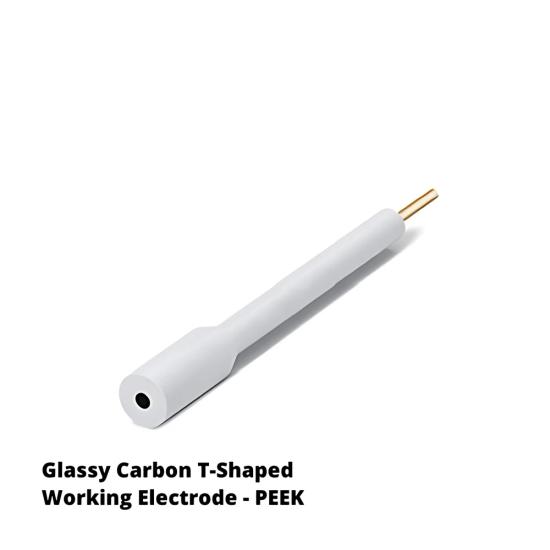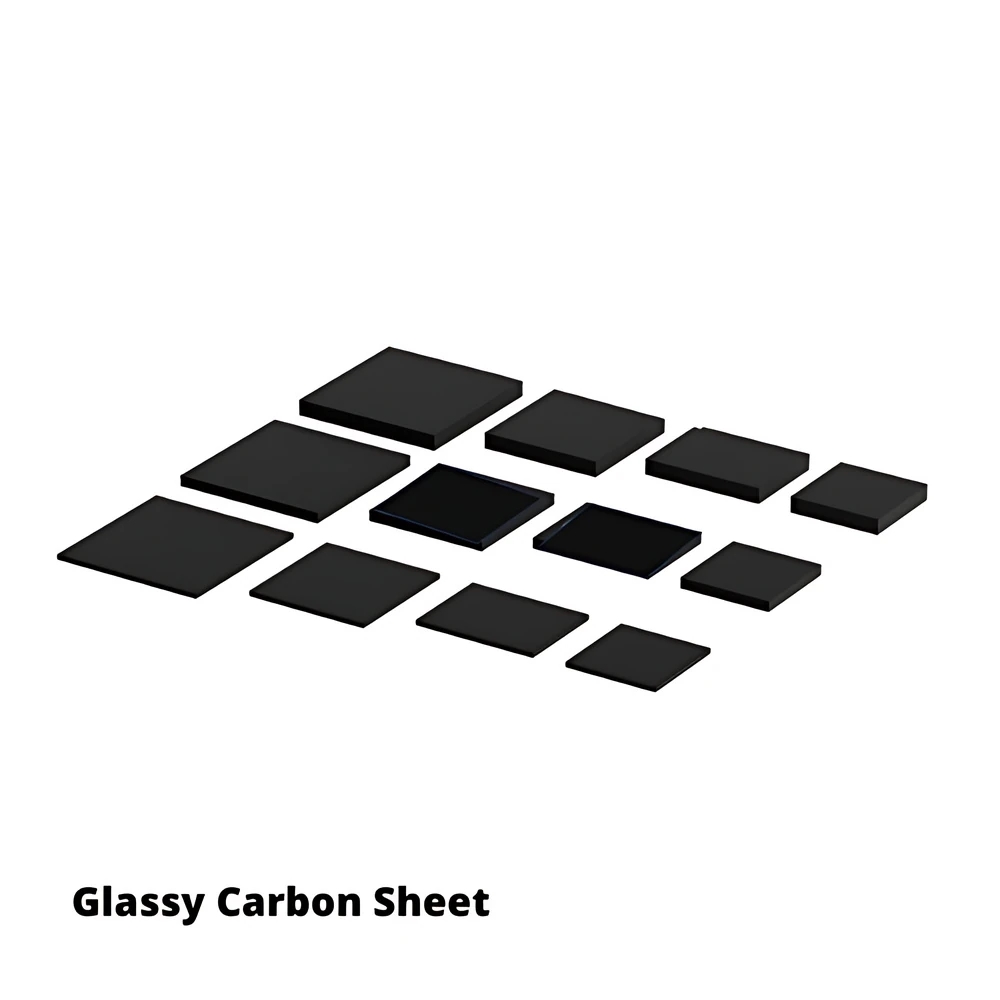
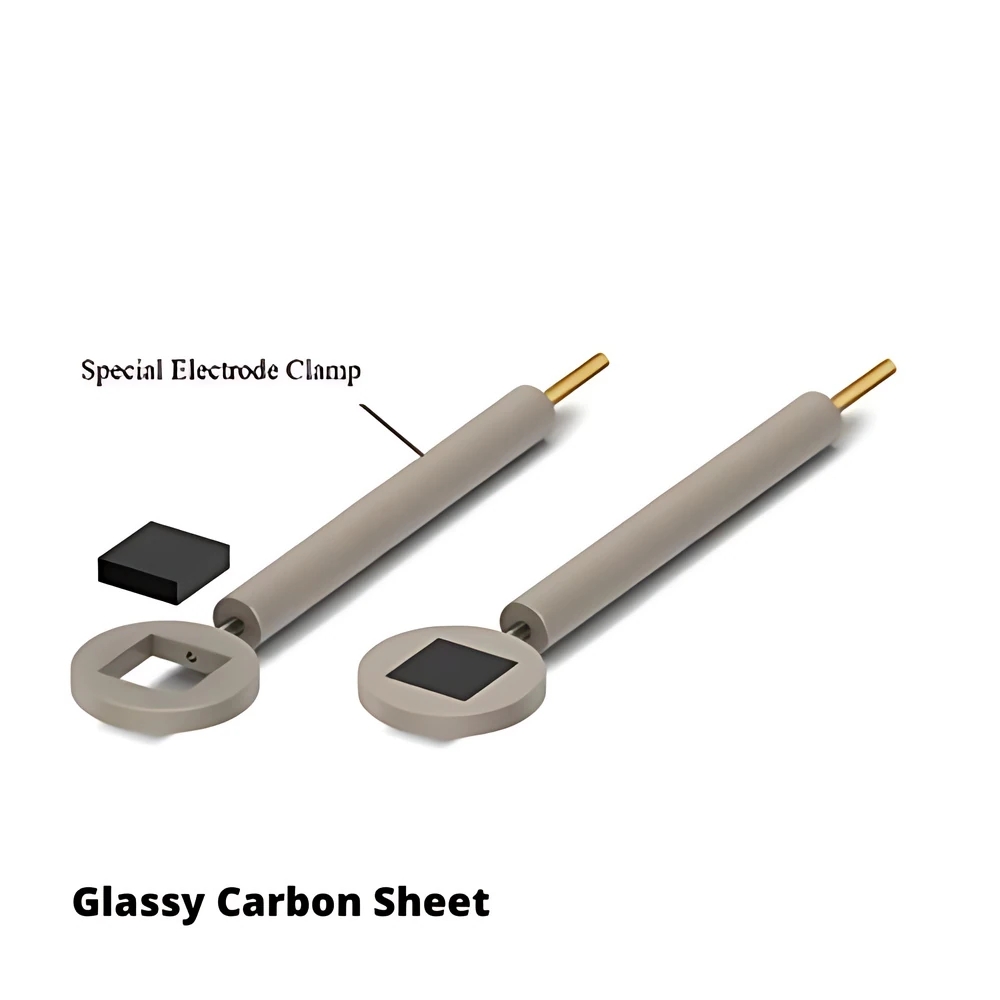
The glassy carbon sheet is a flat, hard material for work in which a glassy carbon surface is used directly as the electrode or substrate. Glassy carbon is gas-impermeable, has no open porosity, resists acids and bases very well and, unlike graphite, does not form ion intercalation compounds. This gives a clean and stable base for coating catalysts or thin films.
The sheets come in US or Japan-origin material, in 1, 2 and 3 mm thicknesses and in eight sizes from 10 × 10 mm to 25 × 25 mm. They work best with the dedicated glassy carbon electrode clamps. The material is hard but brittle, so do not force it when clamping.
| Material | Glassy carbon (US or Japan origin) |
| Thickness | 1 mm, 2 mm, 3 mm |
| Sizes (width × length) | 10 × 10, 10 × 15, 10 × 20, 10 × 25, 15 × 15, 15 × 20, 20 × 20, 25 × 25 mm |
| Model code | GC[width][length]-[thickness]; e.g. GC1520-2 = 15 × 20 × 2 mm |
| Density (typical) | About 1.42-1.54 g/cm³ (depends on type) |
| Hardness (typical) | About 230-340 HV (depends on type) |
| Electrical resistivity (typical) | About 45-50 µΩ·m |
| Porosity | No open porosity; gas-impermeable |
| Temperature limit (typical) | About 500-600 °C in air; much higher in vacuum/inert atmosphere depending on type |
| Recommended connection | Dedicated glassy carbon sheet electrode clamp |
| Custom production | On request |
| Size and Thickness | Description |
| GC1010-1 (10 × 10 × 1 mm) | 10 × 10 × 1 mm (width × length × thickness) |
| GC1010-2 (10 × 10 × 2 mm) | 10 × 10 × 2 mm (width × length × thickness) |
| GC1010-3 (10 × 10 × 3 mm) | 10 × 10 × 3 mm (width × length × thickness) |
| GC1015-1 (10 × 15 × 1 mm) | 10 × 15 × 1 mm (width × length × thickness) |
| GC1015-2 (10 × 15 × 2 mm) | 10 × 15 × 2 mm (width × length × thickness) |
| GC1015-3 (10 × 15 × 3 mm) | 10 × 15 × 3 mm (width × length × thickness) |
| GC1020-1 (10 × 20 × 1 mm) | 10 × 20 × 1 mm (width × length × thickness) |
| GC1020-2 (10 × 20 × 2 mm) | 10 × 20 × 2 mm (width × length × thickness) |
| GC1020-3 (10 × 20 × 3 mm) | 10 × 20 × 3 mm (width × length × thickness) |
| GC1025-1 (10 × 25 × 1 mm) | 10 × 25 × 1 mm (width × length × thickness) |
| GC1025-2 (10 × 25 × 2 mm) | 10 × 25 × 2 mm (width × length × thickness) |
| GC1025-3 (10 × 25 × 3 mm) | 10 × 25 × 3 mm (width × length × thickness) |
| GC1515-1 (15 × 15 × 1 mm) | 15 × 15 × 1 mm (width × length × thickness) |
| GC1515-2 (15 × 15 × 2 mm) | 15 × 15 × 2 mm (width × length × thickness) |
| GC1515-3 (15 × 15 × 3 mm) | 15 × 15 × 3 mm (width × length × thickness) |
| GC1520-1 (15 × 20 × 1 mm) | 15 × 20 × 1 mm (width × length × thickness) |
| GC1520-2 (15 × 20 × 2 mm) | 15 × 20 × 2 mm (width × length × thickness) |
| GC1520-3 (15 × 20 × 3 mm) | 15 × 20 × 3 mm (width × length × thickness) |
| GC2020-1 (20 × 20 × 1 mm) | 20 × 20 × 1 mm (width × length × thickness) |
| GC2020-2 (20 × 20 × 2 mm) | 20 × 20 × 2 mm (width × length × thickness) |
| GC2020-3 (20 × 20 × 3 mm) | 20 × 20 × 3 mm (width × length × thickness) |
| GC2525-1 (25 × 25 × 1 mm) | 25 × 25 × 1 mm (width × length × thickness) |
| GC2525-2 (25 × 25 × 2 mm) | 25 × 25 × 2 mm (width × length × thickness) |
| GC2525-3 (25 × 25 × 3 mm) | 25 × 25 × 3 mm (width × length × thickness) |
For sizes and specifications not listed above, you can request a custom quotation through the Quote Form.


 Türkçe
 Engilish