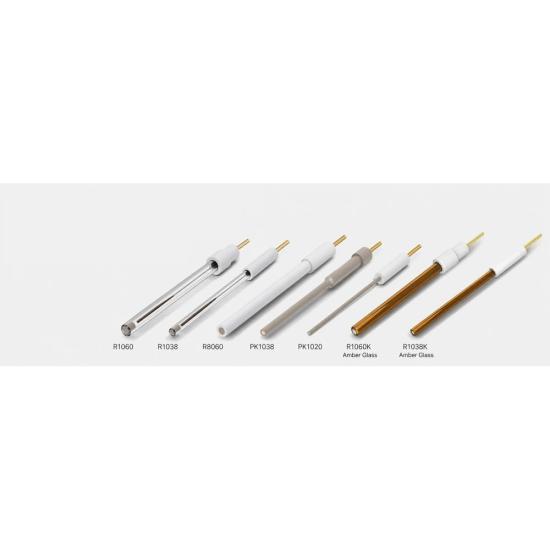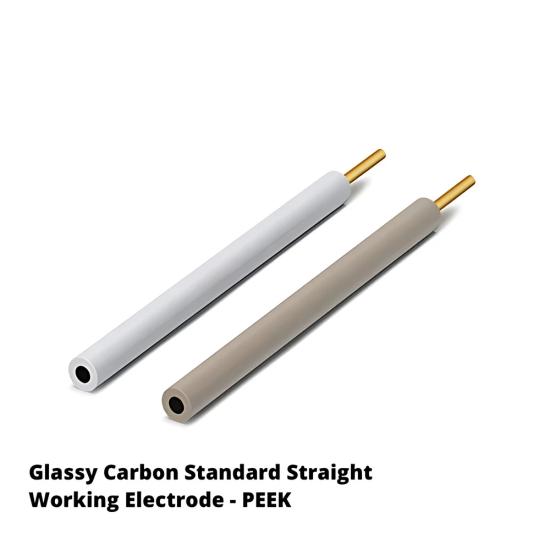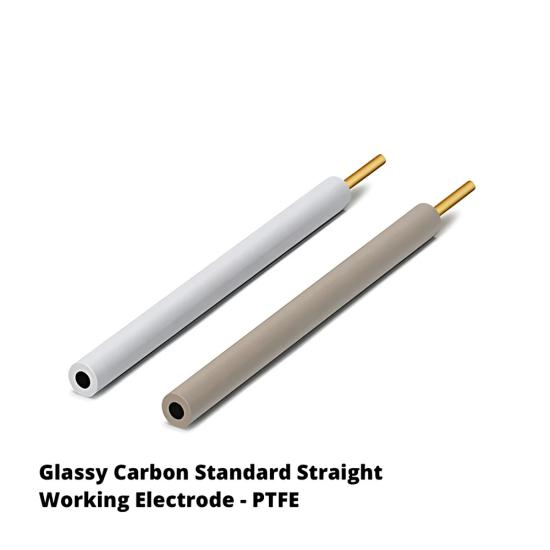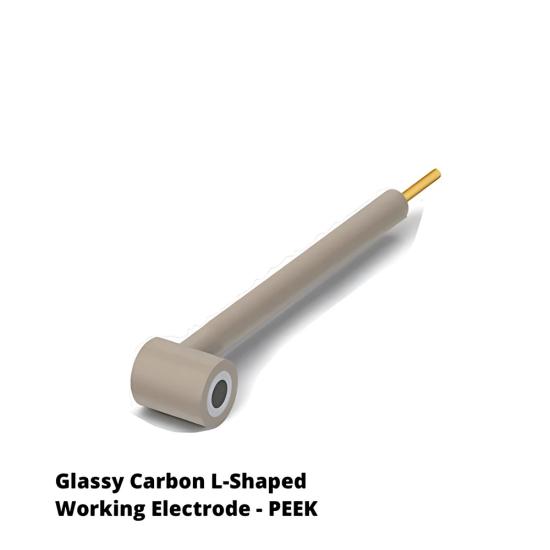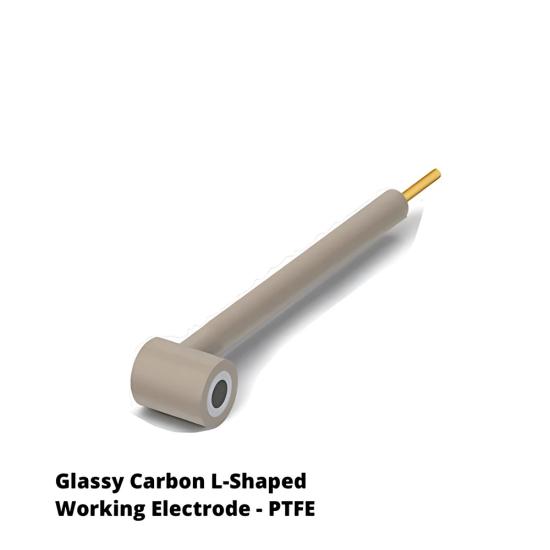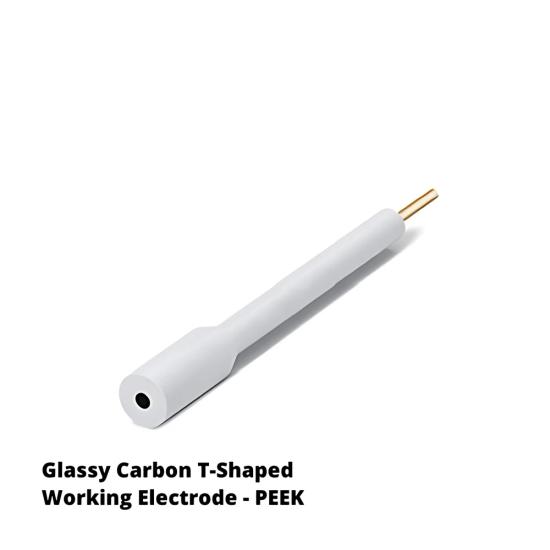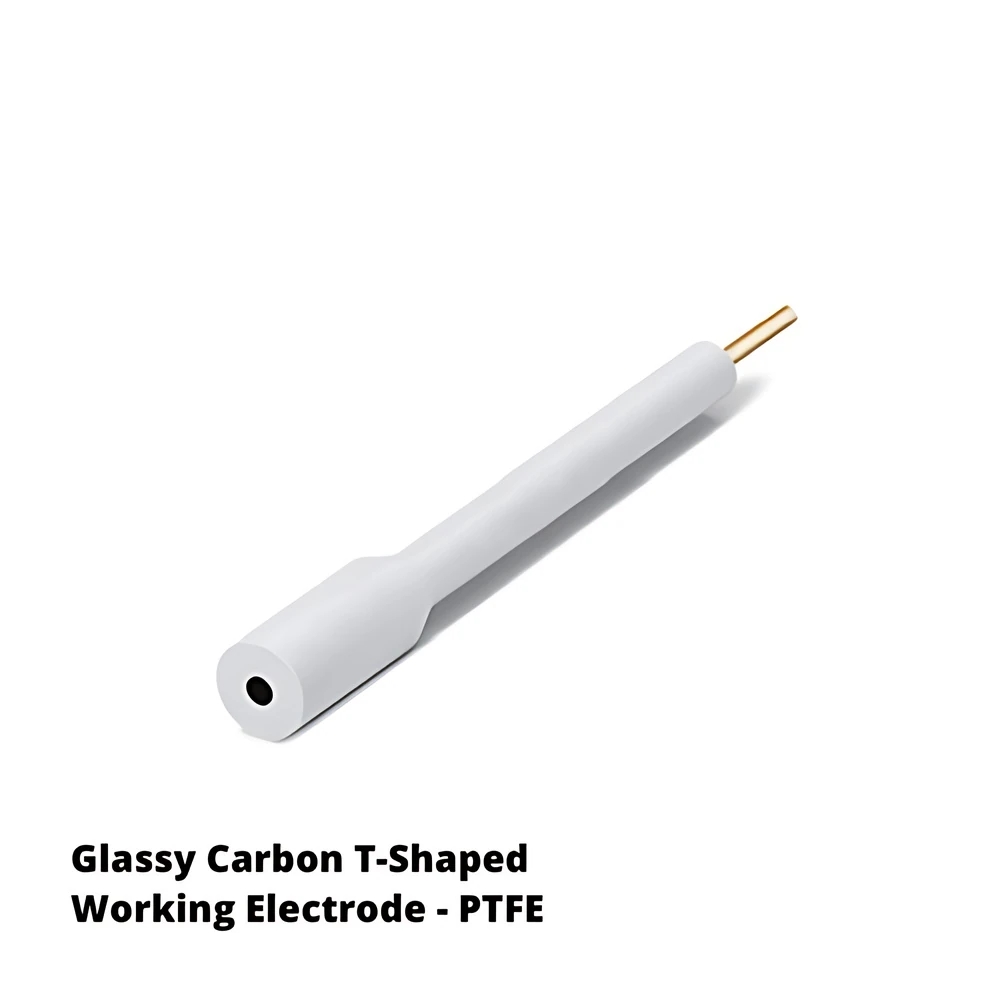
The active surface is a flat glassy carbon disk at the tip of an insulating body. Thanks to its chemical stability and wide potential range, glassy carbon is the most frequently used carbon electrode material; the wide range comes from its high overpotential for hydrogen and oxygen evolution. Electrocatalysis tests are run by drop-casting catalyst ink onto the disk, and it is also common in voltammetry and sensor work.
This version has a T-shaped PTFE body: the lower part is a wider cylinder, with the glassy carbon disk on its end face. The T type is chosen to fit the body size required by specific cells or holders. Disk diameters: Ø1–6 mm (US) or Ø1–10, 15, 20 mm (Japan). PTFE is inert to nearly all chemicals but soft. Straight, L-shaped and PEEK T-type versions are separate products.
| Electrode type | Glassy carbon disk working electrode |
| Electrode shape | T-shaped; lower body section is a wider cylinder, disk on its end face |
| Body material | PTFE (polytetrafluoroethylene) |
| Disk diameter | US-origin: 1, 2, 3, 4, 5, 6 mm · Japan-origin: 1–10, 15, 20 mm |
| Glassy carbon length | 5–10 mm (manufacturer data) |
| Body / total length | 60 mm / ≈75 mm (manufacturer data) |
| Connection | Gold-plated pin |
| Approx. potential window (vs. RHE) | 0.1 M H₂SO₄: ≈ −0.42 to +1.76 V · 0.1 M NaOH: ≈ −0.64 to +1.66 V; depends on electrolyte and purity |
| Polishing | Alumina slurry on microcloth (final step 0.05 µm), then rinse with pure water; if needed, ultrasonic cleaning for no more than 5 minutes |
| Body chemical resistance | Inert to nearly all chemicals and solvents; attacked only by very reactive substances such as elemental alkali metals, elemental fluorine and chlorine trifluoride |
| Operating temperature | Not specified for this product. One electrode maker recommends 10–25 °C for similar PTFE-body disk electrodes; a body expanding with heat can break the seal |
| Origin and Diameter | Description |
| US-Origin 1 mm | US-origin glassy carbon, Ø1 mm disk |
| US-Origin 2 mm | US-origin glassy carbon, Ø2 mm disk |
| US-Origin 3 mm | US-origin glassy carbon, Ø3 mm disk |
| US-Origin 4 mm | US-origin glassy carbon, Ø4 mm disk |
| US-Origin 5 mm | US-origin glassy carbon, Ø5 mm disk |
| US-Origin 6 mm | US-origin glassy carbon, Ø6 mm disk |
| Japan-Origin 1 mm | Japan-origin glassy carbon, Ø1 mm disk |
| Japan-Origin 2 mm | Japan-origin glassy carbon, Ø2 mm disk |
| Japan-Origin 3 mm | Japan-origin glassy carbon, Ø3 mm disk |
| Japan-Origin 4 mm | Japan-origin glassy carbon, Ø4 mm disk |
| Japan-Origin 5 mm | Japan-origin glassy carbon, Ø5 mm disk |
| Japan-Origin 6 mm | Japan-origin glassy carbon, Ø6 mm disk |
| Japan-Origin 7 mm | Japan-origin glassy carbon, Ø7 mm disk |
| Japan-Origin 8 mm | Japan-origin glassy carbon, Ø8 mm disk |
| Japan-Origin 9 mm | Japan-origin glassy carbon, Ø9 mm disk |
| Japan-Origin 10 mm | Japan-origin glassy carbon, Ø10 mm disk |
| Japan-Origin 15 mm | Japan-origin glassy carbon, Ø15 mm disk |
| Japan-Origin 20 mm | Japan-origin glassy carbon, Ø20 mm disk |
For sizes and specifications not listed above, you can request a custom quotation through the Quote Form.


 Türkçe
 Engilish