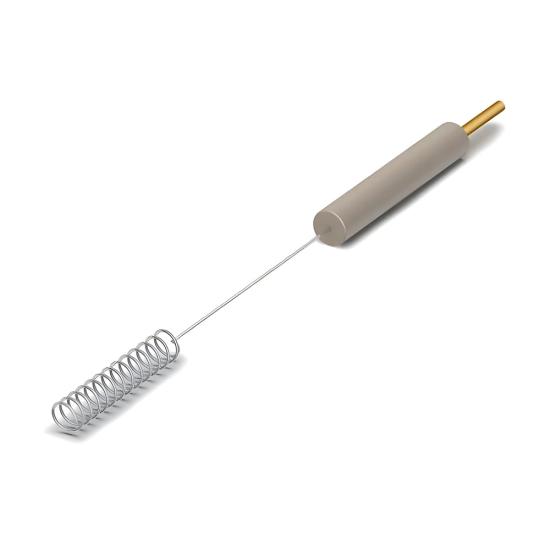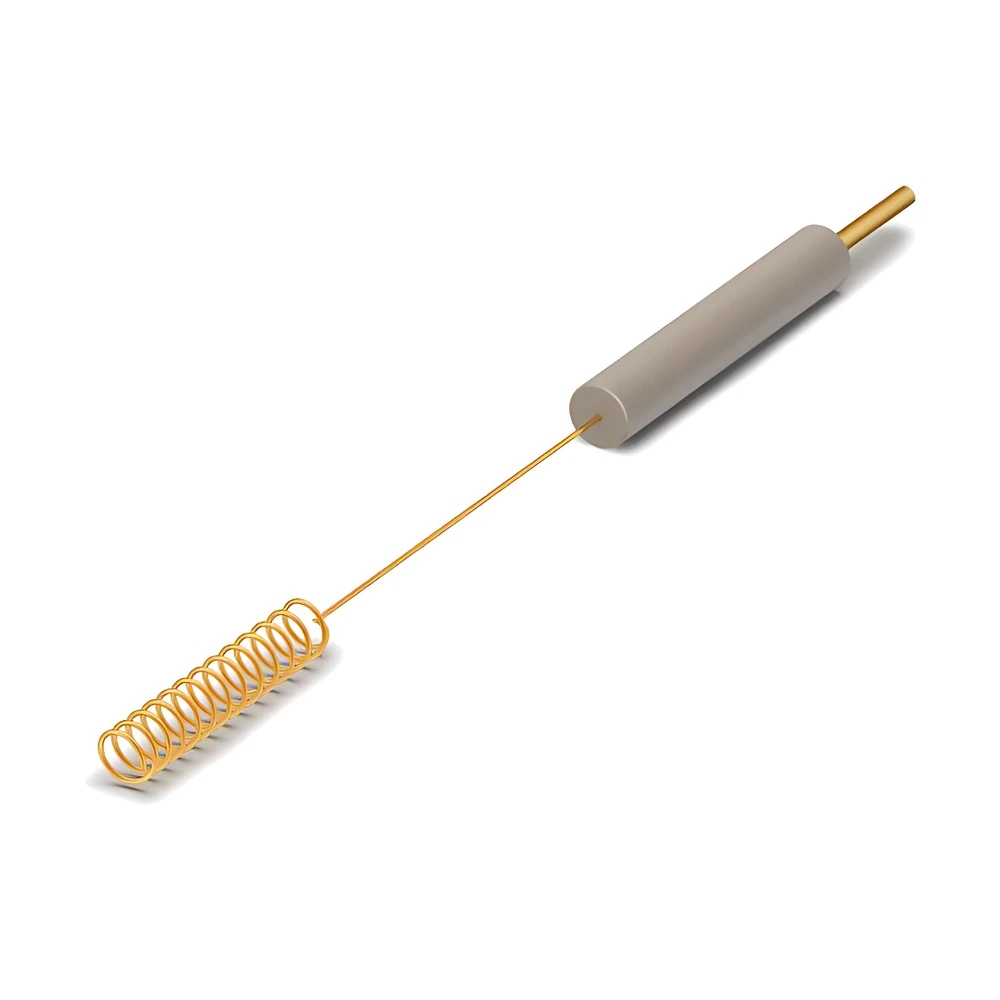
The gold spiral wire counter electrode is made from Ø0.5 mm gold wire with 230 mm exposed length, the end of which is wound into a spring (spiral) of about Ø4 mm. It is made to order; please request a quotation for price and lead time.
It is used as the auxiliary electrode that closes the current circuit in a three-electrode cell. Because a platinum counter electrode can dissolve at high anodic potentials and redeposit on the working electrode, some studies of platinum-free catalysts use a gold or carbon counter electrode instead. Gold can also dissolve in chloride-containing solutions and at high anodic potentials, so its suitability in such media should be checked separately.
| Electrode type | Gold spiral wire counter (auxiliary) electrode with insulating body |
| Electrode material | Gold |
| Wire diameter | Ø0.5 mm |
| Exposed wire length | 230 mm |
| Spiral (spring) diameter | About Ø4 mm (manufacturer data) |
| Approx. geometric area (π·d·L) | ≈3.6 cm² (if all exposed wire is immersed) |
| Media note | Gold can dissolve in chloride-containing solutions and at high anodic potentials; check suitability before the experiment under these conditions. In organic solvents the solvent compatibility of the insulating body must be checked separately |
| Cleaning | After use rinse with a suitable solvent, then with high-purity water; check the surface for deposits and run a blank scan if cross-contamination is possible. Do not flame-anneal electrodes with a polymer body |
| Mechanical note | Gold wire is soft and the spiral deforms easily. Do not stretch the spring or bend the wire repeatedly |
| Connection | Connects to the counter electrode (CE/auxiliary) lead of the potentiostat. Contact pin type and cell/cable fit can be confirmed before ordering |
| Production and price | Made to order; price and lead time are given on quotation |


 Türkçe
 Engilish