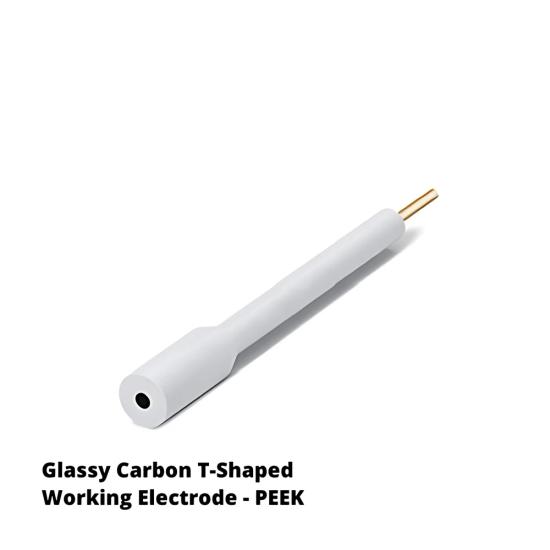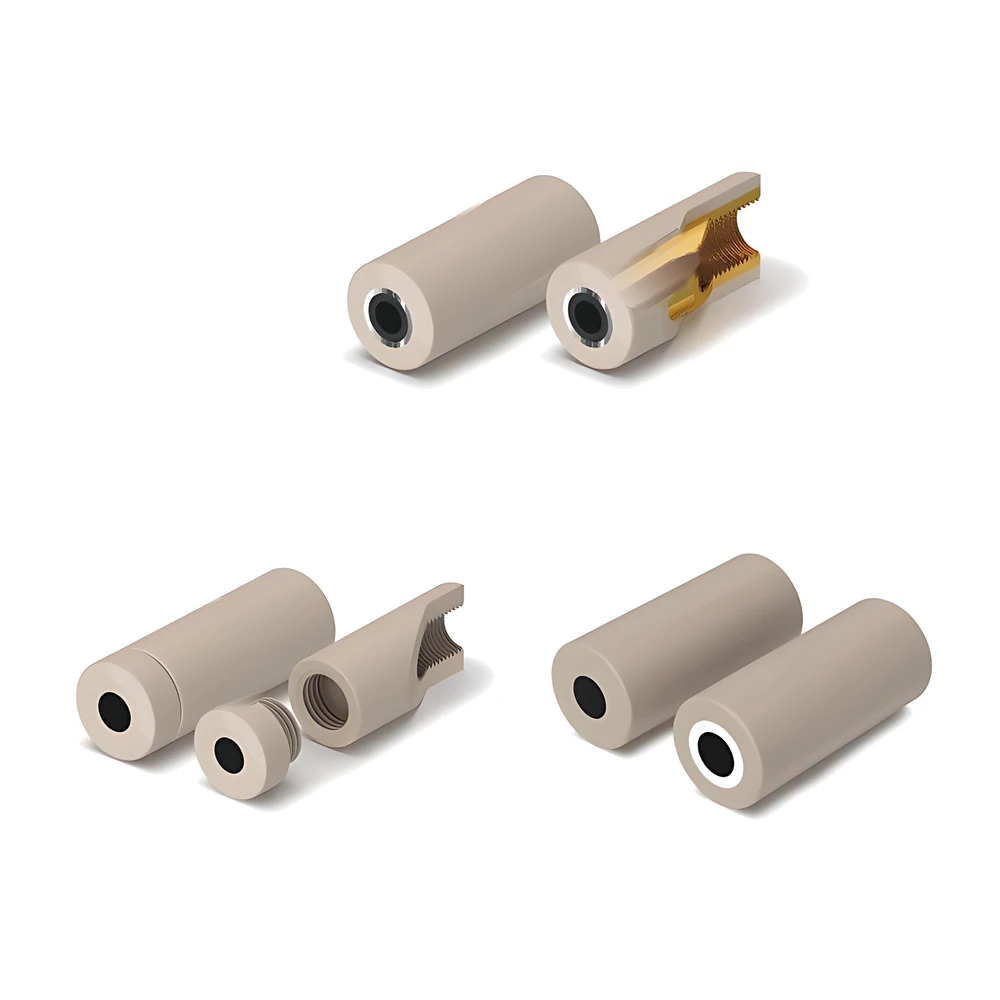
A rotating ring-disk electrode (RRDE) has a ring electrode around the central disk, separated by a thin insulating gap. During rotation, products formed at the disk flow outward over the ring, which is held at its own potential to capture and measure them. A typical use is measuring the hydrogen peroxide (H₂O₂) formed during oxygen reduction (ORR) and the electron transfer number; a bipotentiostat is required.
This model is compatible with common US-type rotators: Ø5.6 mm disk, platinum ring and external thread connection. The disk can be glassy carbon, platinum or gold. The share of disk product caught at the ring is the collection efficiency (N) and depends only on disk and ring size; this model's ring dimensions and N are confirmed before ordering. The Japanese-type model (Ø4 mm disk) suits a different rotator connection.
| Electrode type | Rotating ring-disk electrode tip, US type (rotator not included) |
| Compatibility | Common US-type rotators |
| Disk | Ø5.6 mm; glassy carbon, platinum or gold |
| Ring | Platinum |
| Connection | External thread |
| Geometric disk area | 0.246 cm² |
| Collection efficiency (N) | Depends on ring dimensions; confirmed before ordering |
| Collection efficiency definition | N = |ring current| / |disk current|; verified experimentally with a reversible redox couple such as ferri/ferrocyanide |
| Required equipment | Bipotentiostat (two working electrode channels for disk and ring) and a compatible rotator |
| Custom production | Gold ring; high-temperature (300 °C) version: on request |
| Type and Material | Description |
| US Type - Glassy Carbon 5.6 mm | Rotating ring-disk electrode with platinum ring, us type - glassy carbon 5.6 mm |
| US Type - Platinum 5.6 mm | Rotating ring-disk electrode with platinum ring, us type - platinum 5.6 mm |
| US Type - Gold 5.6 mm | Rotating ring-disk electrode with platinum ring, us type - gold 5.6 mm |
For sizes and specifications not listed above, you can request a custom quotation through the Quote Form.


 Türkçe
 Engilish