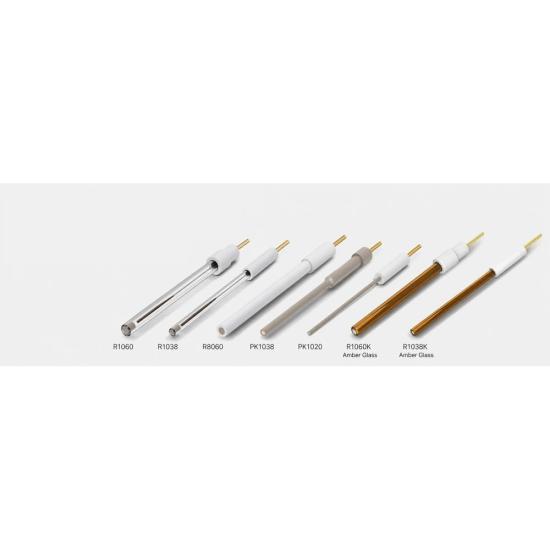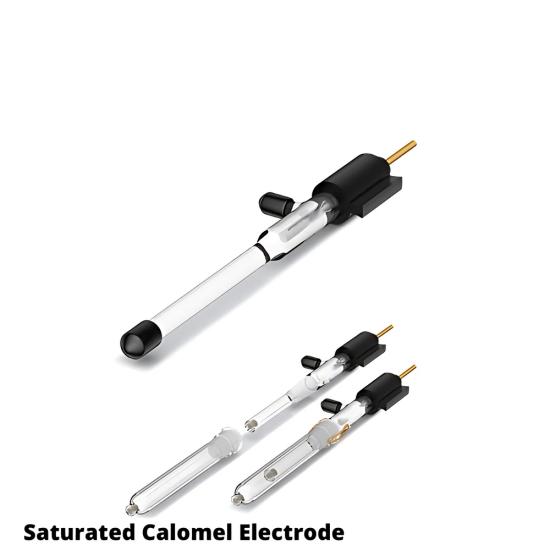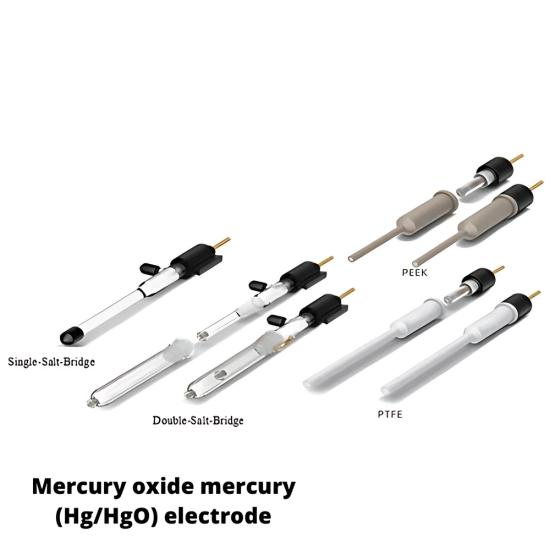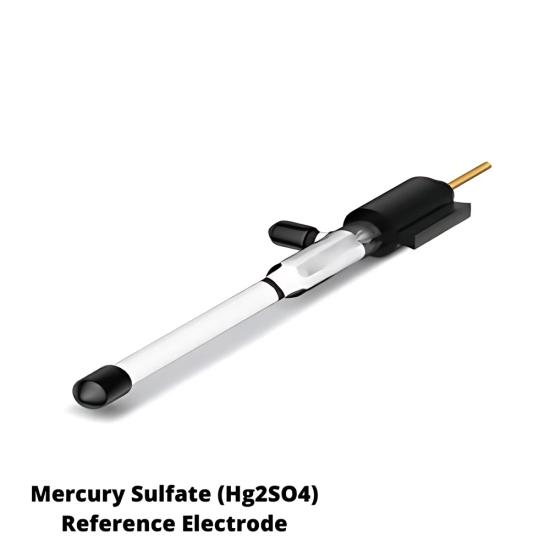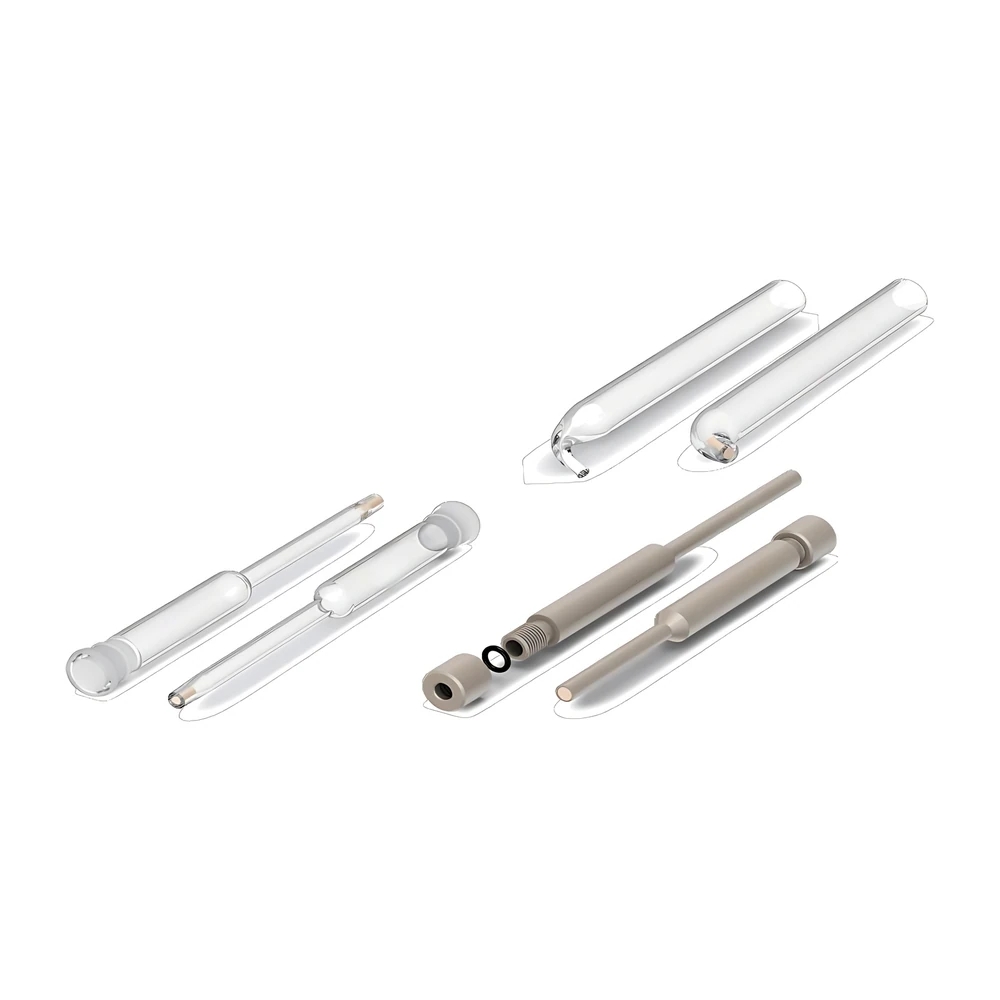
A salt bridge is an electrolyte-filled link placed between the reference electrode and the test solution. It keeps an ionic path open while slowing direct mixing of the two solutions, so ions such as chloride or silver pass less easily from the reference into the cell, and contaminants pass less easily from the cell into the reference. A salt bridge is used in acidic or alkaline solutions or when the reference is sensitive to contamination.
A Luggin capillary is a special fine-tip salt bridge: bringing its tip close to the working electrode reduces the potential drop caused by solution resistance (iR). If the tip is too close it shields the surface; the general rule is a distance of at least twice the tip diameter. An overly narrow tip raises the impedance of the reference.
| Product type | Salt bridge / Luggin capillary |
| Model options | Straight 140 mm, straight 170 mm, bent, fine-tip Luggin capillary |
| Filling solution | A solution compatible with the reference filling or the test electrolyte; saturated KNO₃ to avoid chloride, KCl for KCl-based references |
| Selection principle | The bridge solution must be chemically compatible with both the reference side and the test solution; K⁺, Cl⁻ and NO₃⁻ have similar ionic mobilities, so these salts are common choices for keeping the junction potential small |
| Incompatible combinations | In solutions containing Ag⁺, Hg²⁺ or Pb²⁺ a chloride bridge can precipitate and clog the tip; in perchlorate solutions a K⁺-containing bridge can precipitate KClO₄ |
| Filling | Do not leave air bubbles inside; keeping the bridge liquid level above the test solution reduces contaminant ingress from outside |
| Tip diameter and resistance | A very narrow tip raises the reference impedance and can make the potentiostat unstable during measurement |
| Luggin tip position | Keep the tip at least twice its own diameter from the working electrode; closer shields the surface and distorts the current distribution |
| Limitation | A Luggin capillary reduces but does not eliminate iR drop; apply iR compensation as well if needed |
| Cleaning | After use, empty the solution and rinse with pure water; if the tip dries, salt can crystallize |
| Model | Description |
| Straight 140 mm | Straight type, 140 mm |
| Straight 170 mm | Straight type, 170 mm |
| Bent Salt Bridge | Bent type |
| Luggin Capillary | Fine-tip Luggin capillary |
For sizes and specifications not listed above, you can request a custom quotation through the Quote Form.


 Türkçe
 Engilish