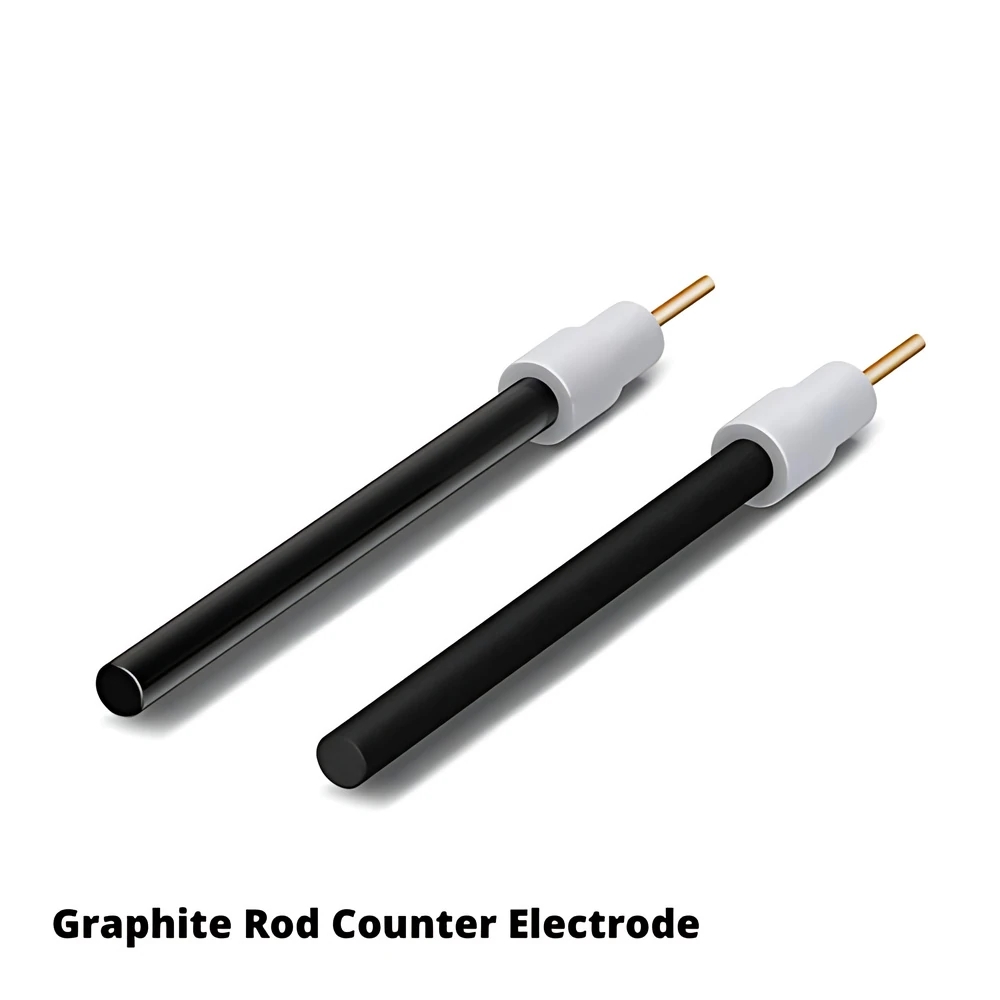
The graphite rod counter electrode is an economical auxiliary electrode that closes the current circuit in a three-electrode cell. It is chosen where platinum is not needed and especially where platinum could dissolve and redeposit on the working electrode and distort the result: in tests of Pt-free catalysts (e.g. oxygen reduction, ORR) a platinum counter electrode can make the activity look higher than it is, whereas graphite does not show this effect.
Graphite is not an inert metal. At high anodic potentials the carbon can oxidize and the surface can wear, and its porous structure can carry residue from a previous electrolyte. Therefore dedicate a rod to one electrolyte system. All models are made of 99.99% purity graphite; this high purity reduces the risk of carrying metal impurities into the solution.
| Electrode type | Graphite rod counter (auxiliary) electrode |
| Rod diameter | 6 mm |
| Rod length | 75 mm or 100 mm (with body); bare rod 75 mm |
| Purity | 99.99% (all models) |
| Construction options | With body (insulating sheath) or bare rod without body |
| Approx. side area (π·d·L) | ≈1.9 cm² per 10 mm of immersed length; for a bare rod all immersed surface counts, for the bodied model only the exposed part |
| Compatible media | An economical alternative to platinum in aqueous electrolytes. At high anodic potentials (especially in the oxygen-evolution region) carbon can oxidize to CO/CO₂ and the surface can degrade; consider platinum or another counter electrode under such conditions |
| Contamination / porosity | Graphite is porous and can carry residue from a previous electrolyte; use a separate rod for each electrolyte system |
| Cleaning and preparation | Before first use, lightly clean the surface with fine abrasive paper, sonicate in pure water, then check with a blank scan in the electrolyte. On a bare rod keep the connection clip out of the solution |
| Connection | Connects to the counter electrode lead of the potentiostat; on a bare rod the clip is attached directly to the graphite. The contact pin type of the bodied model can be confirmed before ordering |
| Limitation | Not as inert as platinum; in long high-current/anodic work it can wear and detached carbon particles may reach the working electrode |
| Custom production | On request (length) |
| Model | Description |
| Graphite Rod Electrode 6 × 75 mm (99.99%) | High-purity graphite (99.99%), with body |
| Graphite Rod Electrode Long 6 × 100 mm (99.99%) | High-purity graphite (99.99%), extended length, with body |
| Bare Graphite Rod 6 × 75 mm (99.99%) | Bare rod without body, high-purity graphite (99.99%) |
For sizes and specifications not listed above, you can request a custom quotation through the Quote Form.


 Türkçe
 Engilish